OP.GG Player Intelligence Product concept
A hundred matches.One readable story.A hundredmatches. Onereadable story.
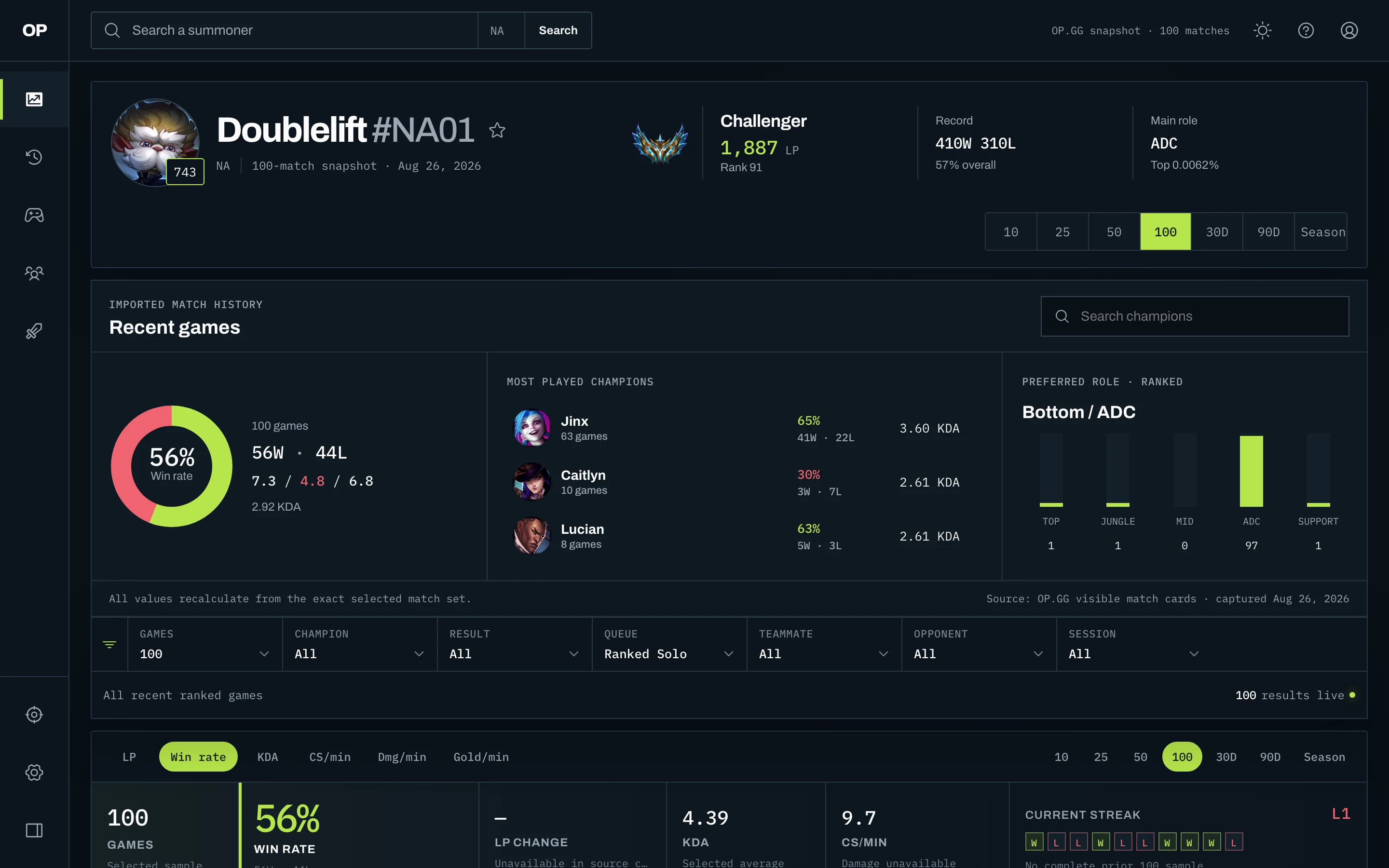
Collins Creative designed and built an interactive concept for League of Legends player analysis. It connects one 100-match snapshot to trends, filters, sessions, teammates, and match detail, and it marks every field the source did not include instead of guessing.
The concept, interactive
Pick a range.
Follow the evidence.
Switch between the latest 10, 25, 50, or 100 games, change a filter, and open a match, champion, or teammate. Everything recalculates from the same fixed snapshot.
Search, comparison, account, and live-game controls are not connected to Riot in this concept.
The challenge
The data was there. The story was buried.
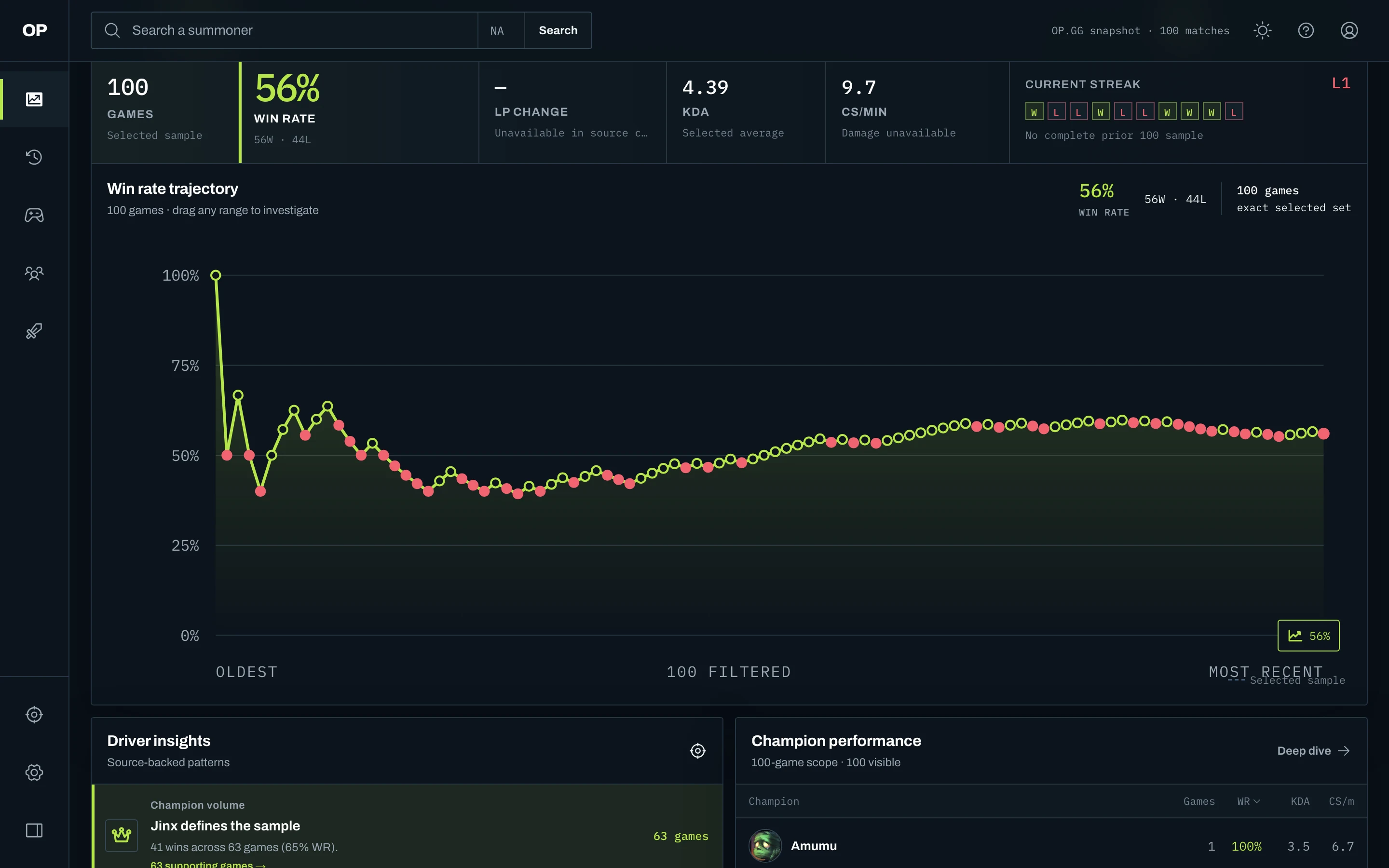
A player profile holds rank, champion history, individual games, sessions, teammates, opponents, and dozens of performance numbers. Adding another statistic was not the problem. Seeing what those records mean together was.
We set out to make the first five seconds useful, then keep deeper evidence one step away for anyone who wants to check a trend, a teammate, a session, or a single game.
Interaction design
Every conclusion,
next to its evidence.
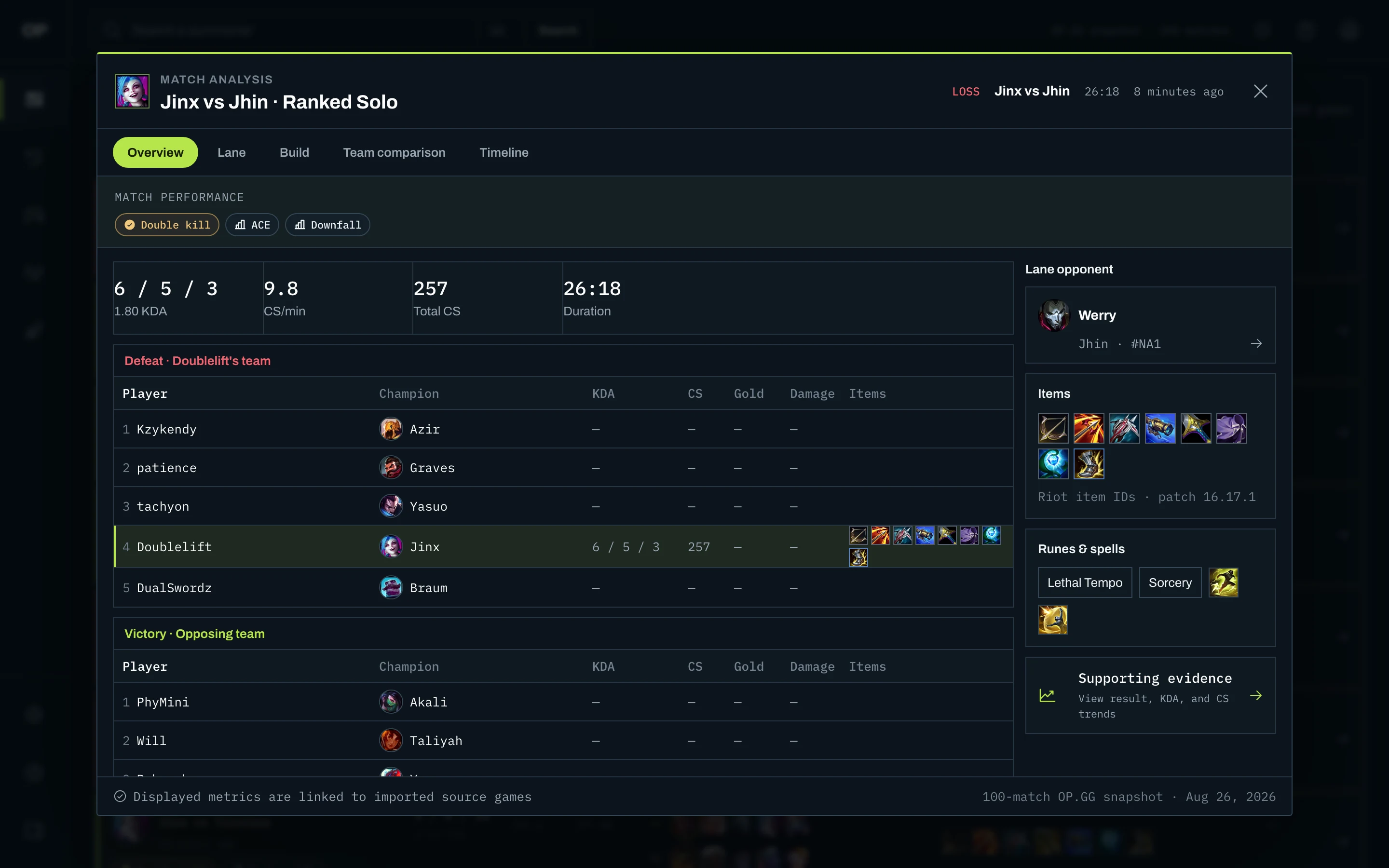
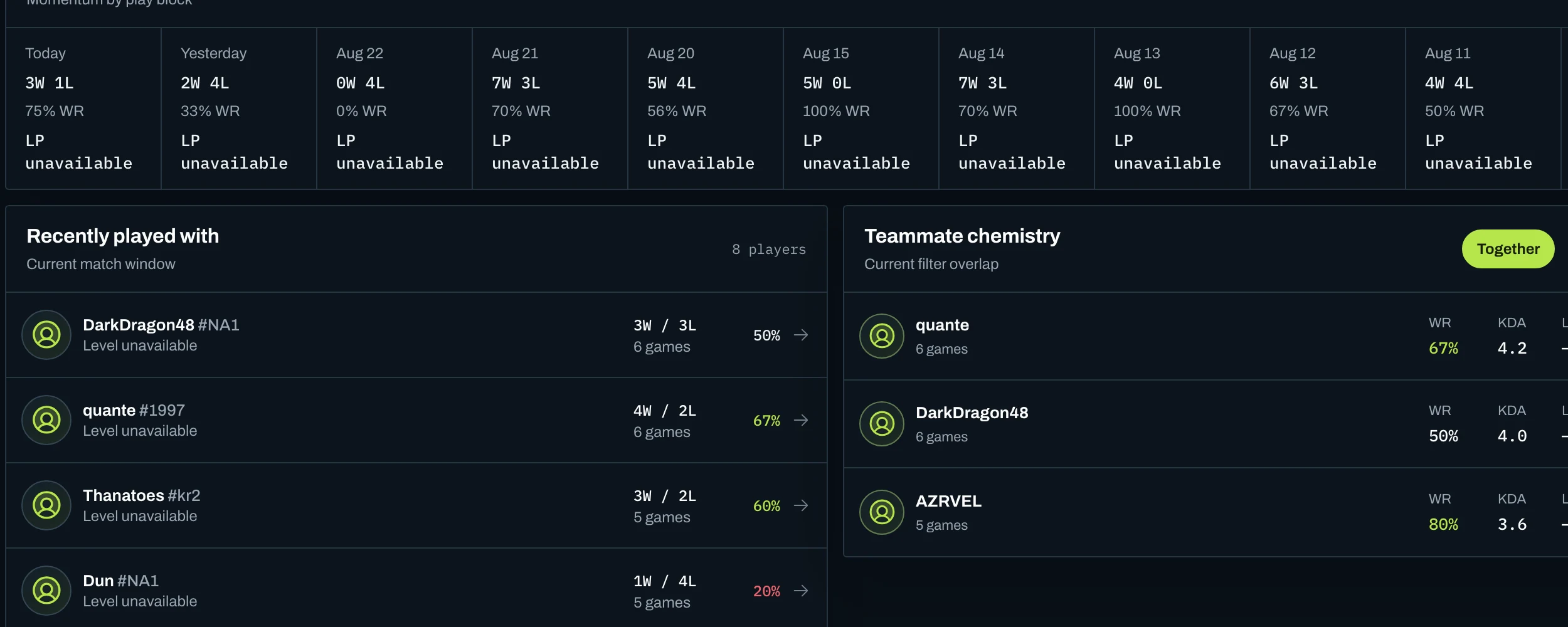
Seven global filters, from champion and result to teammate, opponent, and session, apply to every panel at once. When someone wants more, a focused workspace opens without losing the selected player or match set.
Data integrity
Show what the source has.
Label what it doesn't.
The concept uses the newest 100 visible Ranked Solo match cards on Doublelift's OP.GG profile, captured on August 26, 2026: 56 wins and 44 losses. Nothing is refreshed live.
Fields the match cards never contained are shown as unavailable, not as zeros or estimates.
Kept from the source
Connected to each imported game and used in every calculation.
- Result
- Queue
- Duration
- Champion
- K/D/A
- CS and CS/min
- Final items
- Summoner spells
- Runes
- Both rosters
- Lane opponent
- Patch
Marked unavailable
Not present in the source cards, so the interface says so.
- LP per match
- Damage
- Gold
- Lane differential
- Kill participation
- Objectives
- Build order
- Timeline events
Responsive system
Dense, without
being squeezed.
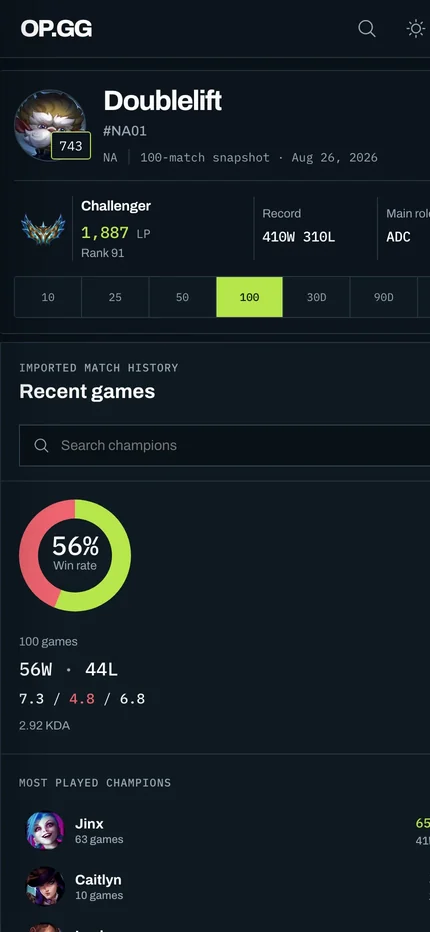
On a phone the compact desktop navigation becomes a full-width menu, and identity, range controls, filters, tables, and deep dives reflow into one reading path.
Horizontal rails stay only where a comparison needs them; the page itself never scrolls sideways.
What we made
From overview
to evidence.
Source-labeled overview
Rank, record, role, champion mix, and recent form, with the snapshot date and match count always visible.
Connected filters and ranges
Seven filters plus match-count and date ranges, all recalculating every panel from the same imported games.
Reusable deep dives
Match, champion, teammate, and session workspaces built from one visual system.
Honest data model
A provenance record of which fields came from the source and which stay unavailable.
Not more data.
A faster way to a conclusion.

Project lead
Brendan Collins
Brendan led the product strategy, information architecture, UX/UI design, data presentation, and front-end build for the concept.
The key judgment was deciding which facts could be shown directly, which patterns could be derived from the selected matches, and which values had to stay unavailable.
Meet the studioYour next chapter
More data than clarity?
We design products that turn dense records into decisions, and stay honest about what the data can support.
Start a project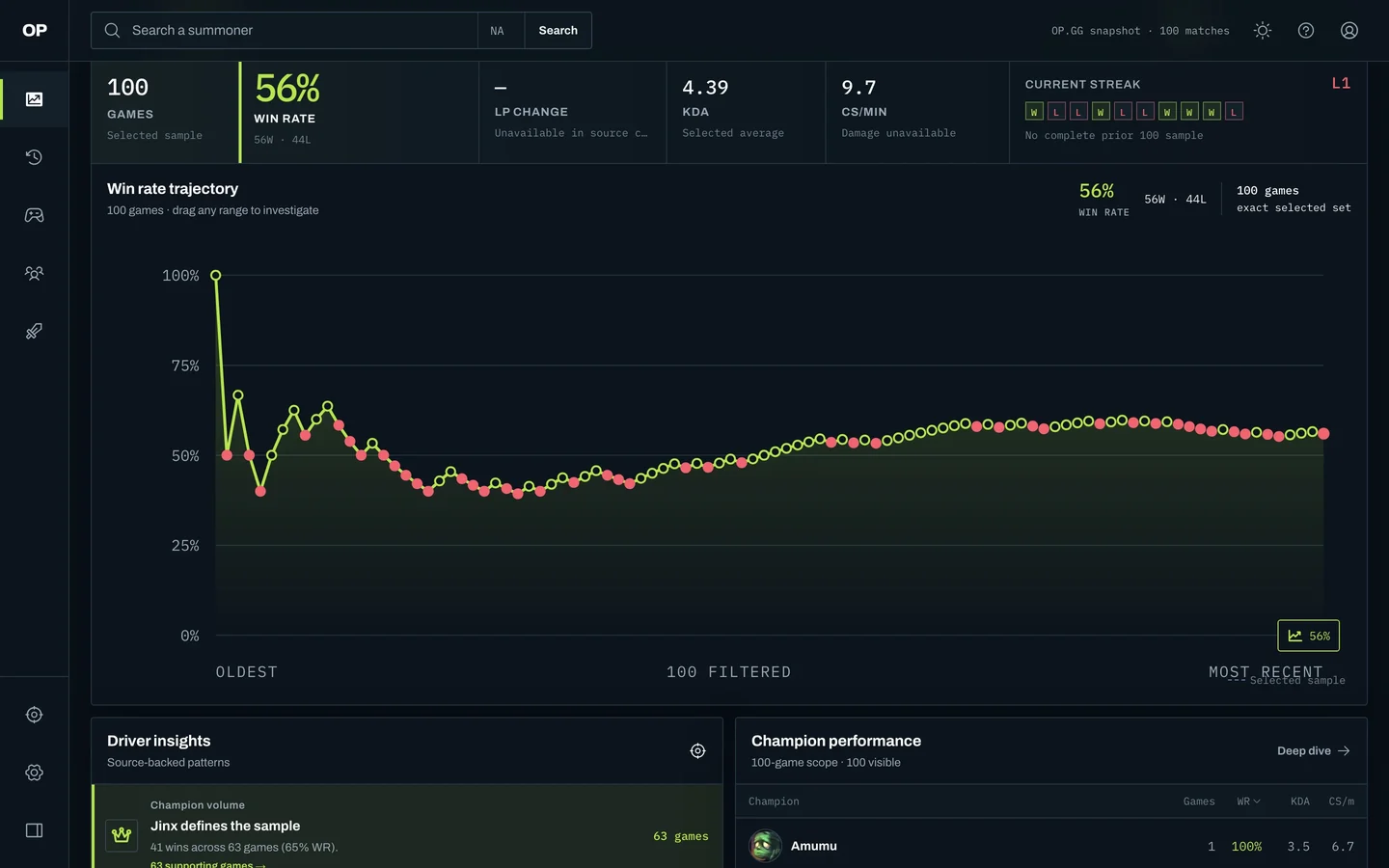
More Collins Creative work